Netflix Didn't Steal Your Weekend — You Left the Door Unlocked and It Walked Right In
Netflix Didn't Steal Your Weekend — You Left the Door Unlocked and It Walked Right In
Let's set the scene. It's Friday at 9 PM. You've survived another week of fluorescent lighting and passive-aggressive Slack messages. You deserve a little downtime. One episode. Maybe two. You're an adult with self-control and a bedtime and a list of productive things you genuinely plan to do Saturday morning.
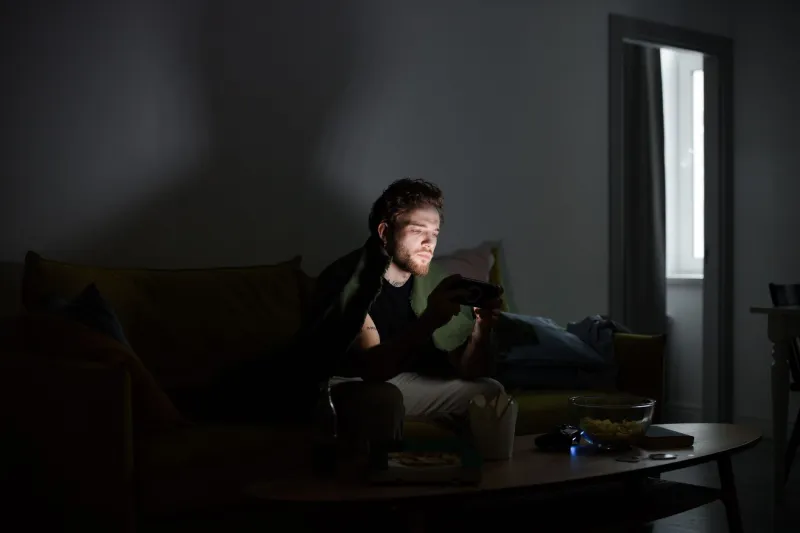
It is now Sunday at 2 PM. You are horizontal. You have consumed fourteen episodes of a show you don't even fully like. The dishes are archaeological. You have not seen sunlight in a manner that counts. And somewhere in a server farm the size of a small nation, an algorithm just logged a successful weekend.
Congratulations. You were the product the whole time.
The Machine Was Never About the Show
Here's the thing nobody wants to say out loud because it ruins the vibe: streaming platforms are not in the entertainment business. They are in the attention retention business. The shows are just the bait. The real product is the uninterrupted block of your conscious hours, packaged and delivered to advertisers, investors, and quarterly earnings reports.
Netflix, Hulu, Max, Disney+, Peacock — every single one of these platforms employs entire teams of behavioral scientists, UX researchers, and data analysts whose sole job is to figure out how to make leaving feel harder than staying. They A/B test thumbnail images. They study the exact frame at which your attention starts to drift. They know — they actually know — the precise psychological moment when you're most likely to close the app, and they've engineered a feature to fire right before that moment happens.
That feature is called autoplay. And it is one of the most quietly devastating inventions in the history of human leisure.
Autoplay Is Not Your Friend. Autoplay Is a Bouncer Who Won't Let You Leave.
Autoplay doesn't ask if you want to continue. It assumes. It counts down from five like you're a bomb that needs defusing, and if you don't actively intervene — if you just sit there in that post-episode stupor where your brain is warm and your body has merged with the couch — it makes the decision for you.
This is not an accident. This is design. Specifically, it's a design principle called friction reduction, which is a polite Silicon Valley way of saying "we removed every obstacle between you and doing the thing we want you to do." Stopping requires action. Continuing requires nothing. And after a long week, nothing is a very easy choice to make.
Pair that with the cliffhanger industrial complex — where every episode ends not with resolution but with a question, a threat, a revelation timed to land right as the credits roll — and you've got a system that doesn't just invite you to keep watching. It dares you to stop.
The Algorithm Knows You Better Than Your Therapist Does
Then there's the queue. The beautiful, endless, suspiciously perfect queue.
Streaming recommendation algorithms are not suggesting things you might enjoy. They are constructing a personalized sedation chamber built from your own viewing history, your pause patterns, your rewatch behaviors, and data points you never consented to share and probably don't know exist. They know what kind of endings make you feel satisfied versus unsettled. They know whether you prefer slow burns or immediate chaos. They know you watched that one documentary about cults at 1 AM on a Tuesday and they have thoughts about what that means for your Friday night.
The queue is not a list. The queue is a mirror that's been slightly warped to make you look like someone who has nowhere better to be.
And so you finish one show and the next thing loads — not randomly, but specifically — and it's exactly weird enough to be interesting, exactly familiar enough to be comfortable, and before you've made any conscious decision at all, you're twenty minutes into something new and the Saturday morning productivity plans are now a grief process.
You Think You're Relaxing. The Platform Thinks You're Converting.
The language we use for binge-watching is telling. We call it vegging out, zoning, decompressing. Passive language for a passive state. We frame it as rest.
But genuine rest — the kind that actually restores you — involves disengagement. Streaming is not disengagement. Streaming is sustained low-grade stimulation delivered in a format specifically calibrated to feel like rest while keeping your brain just activated enough to stay hooked. It's the psychological equivalent of a hotel that's comfortable enough that you never leave to explore the city.
You don't come out of a six-hour binge feeling restored. You come out feeling vaguely guilty, slightly headachy, and somehow both bored and overstimulated. That's not a coincidence. That's the cost of being optimized.
So What Do You Do With This Information?
Nothing, probably. And that's kind of the point.
Knowing the machine exists doesn't automatically free you from it. Cigarette companies put warnings on the box for decades and people kept smoking. Knowing that a slot machine is designed to exploit variable reward psychology doesn't stop Las Vegas from being Las Vegas. Awareness is not the same as immunity.
But there's something to be said for at least watching the show with your eyes open — metaphorically, since your eyes during hour five of a binge have the focus of a goldfish in a snow globe. The least you can do is acknowledge that the relaxation you think you're choosing has been extensively engineered to feel exactly like a choice.
Turn off autoplay. It's buried in the settings because they don't want you to find it, but it's there. Let the episode end and sit in the silence for ten seconds before you decide to keep going. That ten seconds is the only moment in the entire streaming experience that actually belongs to you.
Use it. Or don't. The algorithm will be fine either way.
It's got your Sunday covered.